

Stories persist throughout time, shaping and translating across generations and social evolutions. When we engage in these adapted and translated tales, we confront the familiar and the new. But there is truth in change. It is in the altered that we can more acutely identify what is. That we can appreciate what makes the story itself. In Percy Jackson, this truth is changed. A story about stories, author Rick Riordan, continues the tradition of adaptation in translating ancient myths into our modern world. Here, the messenger god no longer needs winged sandals to deliver information but instead finds himself preoccupied with his shipping empire. The Sphinx no longer vexes travelers with riddles but similarly tortures demigods with standardized tests. It is only natural that the latest adaptation of the hit YA series makes some changes of its own. I am speaking, of course, of the casting of the lovely Leah Sava Jeffries as the co-lead and heroine Annabeth Chase. So much has been debated and agonized over the “controversy of a black actress playing a character initially (over two decades ago) described as blonde (i.e., white.)
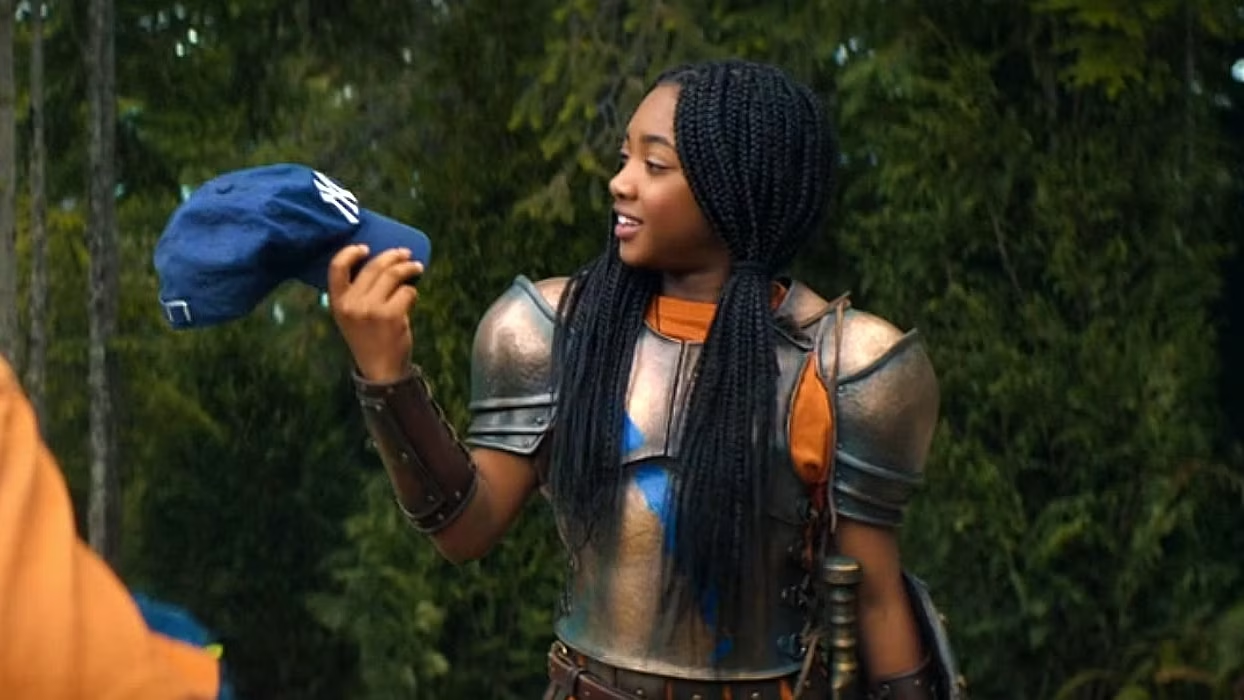
Frankly, it’s tired enough. I heard enough miserable “discourse” to last a lifetime with Zendaya, Anna Diop, Halle, and on and on. Discussions in this manner only serve to put on display the otherness of black girls. To loudly call to attention that we do not belong in these narratives or roles. Outraged detractors lament what has been “taken away” and has been “corrupted.” In this sense, the black girl is not just a negative presence but subtractive. This pessimistic perspective limits one’s imagination and blocks the path toward empathy. They cannot then recognize what new truths emerge as a result of Jeffries’ Annabeth. From her, we are given a unique expression of black girlhood that is allowed to be soft.
Why Soft Black Girlhood?
“Soft” black girlhood has become a specific fixation of mine. The idea of girlhood is fascinating because it is not a universal given. Who gets to “just be a girl” has always been up for debate in the United States. Unfortunately, black girls are not allowed to be or be seen as “just girls.” This is the result of adultification bias, which acutely impacts African-American children being seen and/or treated as more mature or older than they are. Black girls, in this way, are perceived as less innocent, more aggressive, and need less protection compared to their white counterparts. In the case of girlhood, black girls are likely to be subjected to standard adultification bias as well as socialized adultification bias. This latter form is borne as a tool to equip black girls with the strength, maturity, and independence they will need to survive structural racism. This adultification is then sort of a necessary evil to combat the other one. But in between one adult-ified rock and a hard place, where is the room for girlhood?

In light of these overbearing societal stressors and expectations, girlhood is not freely offered to black girls; it must be cultivated. The same must be asked for softness. Just as black girls are socialized into premature maturity, we are additionally conditioned into adopting the “strong black woman” persona. This is designed to ward against and cope with racial and gender discrimination. The strong black woman or “Superwoman Schema” can be broken down into five components: 1) Pressure to project strength; 2) Pressure to suppress emotions; 3) Resistant vulnerability; 4) Drive to succeed despite limited resources; 5) Obligation to care for others (over oneself). But who doesn’t want to be strong? Even the American media, after centuries of dehumanizing depictions of black women, finds recent redemption in its strong black female characters. But this is a prison that both protects and afflicts. The strength applauded is the result of mounted societal and environmental pressures. Pressures are akin to the kind that transforms the flammable coal into an unbreakable diamond. Radiant and razor sharp. But not all of us desire this fate, however glamorous. The diamond is only worth as much as its proximity to perfection; thus, it is always under scrutiny. It has no choice but to be strong and beautiful. But the diamond is not invulnerable to itself. When enough internal pressure or “strain” builds up, even the slightest tap can shatter it. That is no life worth aspiring to. It is then that Annabeth, in the body of a black girl, presents a possible Truth about the cultivation of soft black girlhood.
When we meet Leah Sava Jeffries’ Annabeth Chase, there’s no denying it: she’s “that girl.” From being the youngest cabin leader at Camp Half-Blood and leading record-breaking Capture the Flag Campaigns, she is a force to be reckoned with. It’s hard then not to recognize the Superwoman Schema in her character. In the second episode, we’re immediately informed that she’s propelled by her ambition to prove herself. As a leader, she refuses to be vulnerable, projecting an image of strength. When Percy suggests leaving her mother’s hat in Medusa’s basement forever, she suppresses her feelings, answering with an ambivalent “sure.” In the face of danger, she repeatedly moves to sacrifice herself for the sake of Percy and the quest. By and large, she is the “strong black woman,” complete with all the trappings that come with it. She’s also a girl who has not been allowed or allowed herself to be a kid. A runaway at seven, she finds her way to Camp Half-Blood, where she devotes herself to being the epitome of a demigod. Though not explicitly stated, it’s clear that she’s achieved her current leadership role at a very young age. In this way, she experiences both the forced maturity and self-hardening of black girls in America. Thus, her journey marks a path to reclaiming girlhood and cultivating room to be soft.
I’m Just a Girl
The show is aware of this ‘adult-ified’ Annabeth in constructing her character arc this season. Where Percy learns to become a demigod throughout the season, Annabeth is encouraged to be a kid. To understand this journey, we must understand what it means to be an adult. We’re given a glimpse into Annabeth’s interpretation through Luke: “Annabeth’s the strongest warrior in camp. The only way left to prove herself is to go on a quest”. For Annabeth, the only way she can transcend her kid status is by external acknowledgment by the gods, the “ultimate” adults. But once she completes the quest she had waited five years, does she achieve the validation she seeks? The show doesn’t seem to resolve this question by the finale. However, when we compare the progression of Percy and Annabeth’s parallel journey, we find the answer has been there all along. Percy’s struggle with his demigod identity is resolved in a godly showdown with Ares. Here, it is only when Percy completely embraces his identity and the power of Poseidon that he can bring Ares to his knees.

Although it is given less flare, Annabeth, too, finds herself in a similar one-on-one confrontation with Hephaestus in episode 5. Yet this showdown is not waged with iron or a battle of wits; Annabeth doesn’t even defeat Hephaestus. Instead, she only moves Hephaestus into releasing a petrified Percy when she rejects the adult world: “It isn’t how it should be! It isn’t! Eat or be eaten. Power and glory and nothing else matter. Ares is that way, Zeus is that way, my mother is that way….Maybe I was that way once. But I don’t wanna be that way anymore.” In this “battle,” she realizes and accepts that she doesn’t want to be like the adults in her life anymore. It is only then that she receives the validation she has been seeking. However, it does not arrive in laurels in recognition of her achievements as a demigod or as a child of Athena. Her arc is resolved in five simple words from Hephaestus: “You’re a good kid, Annabeth.” Not a warrior. Not a leader or demigod. Hephaestus recognizes and validates Annabeth as the child that she is. It’s not what she had worked and waited for but what she needed to hear. In doing so, he relieves all the expectations and pressures either she or other adults have placed on her. He gives her something that black girls do not always get: a break. She doesn’t have to have all the answers or be perfect all the time. She is still growing and learning. After all, she’s just a girl!
Of course, not all of our internal conflicts can be easily solved with just a few words. Instead, her girlhood has to be something Annabeth actively chooses and fights for. In the finale, we see Annabeth preparing to go home to live with her estranged father for the first time since she ran away. Her decision highlights an awareness that to allow herself space to pursue her girlhood; she has to leave camp. She’s nervous, but Percy reassures her to “just be a kid.” This line points to another crucial aspect of reclaiming girlhood: friends. It’s not enough for us to choose to be kids; we need people who will let us and sometimes push us to be girls.
Creating Space for Softness
Along Annabeth’s journey, we learn to imagine new forms of softness. The concept of “softness” has often been weaponized against black girls to uphold White hegemonic norms of femininity. It has been used to reinforce the idea that black girls and women are not inherently soft or feminine. When I speak of the expressions of Annabeth’s softness (as exhibited through Leah), I point to a softness that already exists within the character and the actress.

While the thematic arc of the series is undoubtedly crafted around Annabeth’s emotional development, I specifically credit Leah with the softness we see in the character. She intended to transfer this “sensitivity and softness” from herself to Annabeth. However, Leah understands Annabeth’s eyes best express this sensitivity and softness. While her postures remain stoic, her eyes betray the emotions stewing beneath the surface. This is by no means the only way we can observe Annabeth’s softness. We catch glimpses of it through the cracks of her fortified walls; gently, she rests her hand on Thalia’s tree, the quiet sting of rejection when Percy claimed he could imagine being friends with her, the creeping insecurity and doubt when confronted with Medusa’s side of the story. From the books, it is certainly a new aspect of the character one might not have initially expected. But it does not negate Annabeth’s ferocity and capability. Instead, Leah’s softness reveals a new truth for Annabeth.
Although she begins the series emotionally estranged, she has always been empathetic. Her backstory is rife with abandonment, rejection, and loss. This “strong black woman” persona is created to protect her from the pain of those experiences. But all that armor can’t erase the fact that she is soft! She is emotionally sensitive and sentimental, believes in a higher power, and has a profound fondness for her friends. Her journey with softness then is not concerned with becoming more feminine or less threatening but about strengthening her emotional relationship with herself and others. The first day of the quest reveals that her inability to empathize with Medusa and to relate/connect with Percy puts her and the team at a disadvantage. Each episode builds up her emotional intelligence or strengthens her personal relationships. She becomes a better friend and a demigod by embracing her softer side. It is the sentimental memory of her dad’s dog that she uses to soothe Cerberus by petting his neck, and her relationship with Percy that prevents them from forgetting each other at the Lotus Casino. Because of her concern (and suspicion), she secretly follows Percy and Luke into the woods. A decision that would save Percy’s life.

The final stage of her emotional development culminates in the form of her camp necklace (complete with her father’s ring). When she ties her camp necklace around Percy’s neck, she not only acutely demonstrates empathy (something she couldn’t do with Medusa) but simultaneously affirms their bond. It’s an incredibly soft moment that’s true to who she is. Softness and strength are not mutually exclusive. Leah forges new ways of imagining a softness that doesn’t sacrifice Annabeth’s strength. Instead, it compliments, rather than dilutes, her strength. In this way, she discards the need for the “strong black woman” by welcoming and acknowledging softness. In recognizing it in her, we can hopefully recognize that softness ourselves. It is as much a part of us, too. We are soft.
Being Claimed

In the world of Percy Jackson, to be claimed by your godly parent is to be acknowledged and accepted. After seeing “Annabeth Chase” and “Leah” trending on X for two days straight soon after making her onscreen debut, it’s safe to say that the PJO fandom has emphatically claimed our girl, especially in Brazil. When I talk about Annabeth’s softness, it goes beyond how it represents itself on the screen; it is how fans interact with it. The reception has been beyond anything I could have expected. Online fans eagerly crop clips of Annabeth’s most emotional moments into TikTok edits cued to “Normal Girl” by SZA or “Not Strong Enough” by Boygenius. They speculate potential hairstyles Annabeth will wear in season two. They rally against those who’ve caused her pain, like her estranged dad, Frederick, and Athena. There is an overall commitment to protecting her and her softness. They reproduce it, reimagining scenes from later books and series in Leah’s image. When they draw her, she is the girl she is. Not hypersexualized or aged up. This softness isn’t just reproduced in art or fancams; even the way they speak of her is soft.

Praise and discussion are soaked in sincere affection and adoration. In doing so, they preserve this as essential to the character. It becomes a new truth that extends beyond the fictional character and attaches itself to the actress playing her. It is how we arrive at “Leahbeth,” an endearing mashup of Leah and Annabeth. Additional epithets created in her honor include minibeth and three apples tall (about her height). It solidifies Leah as Annabeth and creates a new form of attachment. They are one and the same. When they draw Annabeth, it is done with the softness of Leah’s likeness. When they defend Annabeth, they defend Leah. Currently, I am not aware of other such name mashups existing for the other primary actors in the series, including Walker Scobell, who plays the titular protagonist.

For days, I scrolled through hundreds of fanart of Annabeth in the style of Leah. There’s a bizarre sort of exhilaration I get in parsing through them. During the height of online engagement when the series was airing, I found myself liking and bookmarking just about every piece of fanart or edit that drifted across my algorithm. I imagined this must be how my Aunties felt, collecting each bit of news of my achievements for their private memory scrapbooks. Instead of a niece or nephew of my own, it was a girl who was a stranger to me. But still, I couldn’t shake the visceral jolt of deja vu when she stepped on screen. Her familiarity didn’t ring as a literary character I grew up with or someone I might have seen at a family function in passing. I mulled and turned over the idea for days. It wasn’t until I went home for the holidays that it hit me. Somehow, this actress had summoned the phantom of a young girl who once looked back at me in the mirror.
Watching Leah as Annabeth felt like flipping through the old pages of my middle school journal. I couldn’t ignore it. The TV series became a sort of time portal back to that era when I was a 12-year-old black girl with ADHD and undiagnosed social anxiety. Middle school was about finding your box, but everything about me back then felt untranslatable. I struggled to find examples of myself. The black girls I saw on TV weren’t awkward or struggled to maintain friends. I was relegated to just “being myself” for lack of better options. At least I had books, but even then, I could only cobble bits and pieces from Katniss Everdeen, Violet Baudelaire, and Annabeth Chase. And I took that very seriously (somewhere stuck between the floorboards of my house are a pair of cheap, chunky silver earrings in the likeness of an owl. Yes, much like the ones Annabeth wore in The Titan’s Curse, but way less flattering than I hoped they would be). But despite my affinity for the goddess of wisdom, I knew I wasn’t Annabeth. I didn’t have blonde hair and gray eyes. I wasn’t the heroine anyone wrote about or jumped into Tartarus for.
I soon gave up on my adolescent search for an analogy. I had resolved never to revisit anything from my middle school years. I locked adolescent Sophia in a tight box with all her insecurities and threw away the keys (that’s what we adults call “protecting our mental health”). But here she is, 10 years later, looking back at me from the TV screen. How uncanny! I may not have helped to decapitate Medusa, but I know what social rejection feels like. I’ve swallowed my feelings when I felt like breaking. I know what it’s like to be stuck in your head and still struggle to communicate. I know what it’s like to put so much pressure on yourself to please your parents. I know what it’s like to keep people at a distance, to protect yourself from hurt. I know what it’s like to feel you must prove yourself worthy of validation and acceptance. Watching Annabeth’s journey felt like recalling the words of a song I had forgotten I even knew.
A video made the rounds toward the beginning of the year. It was from a black Brazilian girl whose dad had taken her on a special outing. They spent the day shopping for clothes and getting her hair and nails done at the very end to reveal that it all served to give her the appearance of Annabeth Chase. I did start tearing up. I realized that Leah/Annabeth wasn’t just meant for me. She would belong to the millions of black girls who will look to her inward strength and her grace to take with them to fight their own monsters. They will recognize their own beauty, softness, and strength. They will model themselves after her, like the girl in the video. But the truth is girls like her didn’t just materialize. They were always there. Waiting. Just as I had been.




You must be logged in to post a comment.