

This year, I had the incredible opportunity to cover the Toronto International Film Festival for Screen Speck. From world premieres to early-morning press screenings, I definitely kept myself busy (the constant teas and hot chocolates helped). I saw over 30 movies, so I wrote a review roundup of my most-loved or middling watches. (You can read my interview with the director and writer of Freedom Way, a movie I enjoyed, here.) I’m so grateful to Screen Speck for making this possible. Now, on to the movies!

The Life of Chuck (dir. Mike Flanagan)

My favorite film of the festival, The Life of Chuck, won’t be released until next year. And that’s a real shame — not only did it have broad appeal (marked by winning the festival’s People’s Choice Award), but I think the film exudes a kindness and hope that many would find refreshing right now. Based on a Stephen King novella, The Life of Chuck checks in on Chuck Krantz (Tom Hiddleston) at three stages of his life, though its scope goes beyond the man himself. The film’s focus on Chuck gets more apparent as the runtime moves on, but that initial restraint and the gradual revealing of details lets the film create small worlds that already work on their own, even before their relevance is cemented.
From a seemingly unrelated story about people finding one another in an increasingly disastrous world to an astonishing dance break, everything matters in this story. No moment of joy is meaningless; no person is insignificant. The ensemble nature of this movie works to its advantage. It’s hard to write about everything that makes this film so unique without spoiling the structure that ties everything together. One character’s words sum up my feelings exactly: The Life of Chuck is a “strange wonder.” Unapologetically hopeful, this film is a quiet beauty (with an incredibly touching dedication) that connected with me.
Flow (dir. Gints Zilbalodis)

Many films I saw at TIFF this year dealt with imagining the “end of the world.” I’m drawn to films about apocalyptic events and the people who try to make sense of life anyway. Flow is a sunnier packaging of these existential fears, but it’s a movie for all ages. Without dialogue, Flow follows a “found family” of animals who work together to survive a massive flood. There are some physical signs of the human (or human-like) civilization that used to roam the world, but our focus lies instead with a black cat. It gradually meets dogs, birds, monkeys, and more as they escape the rising waters by boat.
Flow’s animation is undoubtedly beautiful, especially its lifelike water and grass. The smooth character animation sometimes felt too much like a video game cutscene, which took me out of things. But as a dog owner, I recognized some of the dog’s subtle movements and facial expressions — an impressive feat that made me sure the other animals’ movements were just as accurate. The lack of dialogue leaves some things delightfully ambiguous (albeit with beautiful presentation) and still manages to tell a sweet story about an animal learning to trust others — even when it’s scary — and to be part of a team. If I’m ever stuck in an apocalyptic flood, I want to be on the nice animal boat.
Dahomey (dir. Mati Diop)

Dahomey is one of the most creative documentary works I’ve ever seen. Dahomey uses a similarly multifaceted structure to address the challenging question of repatriating artifacts from France to Benin. The film is partially narrated by an artifact whose low, rumbling voice tells the story of Beninese history and the dehumanization of artifacts. And, symbolically, Beninese culture). Diop’s mission to immerse the viewer extends to Dahomey‘s sound design. In one scene, the audio becomes muffled as an artifact, and by extension, the viewer is sealed into a box and transported.
This documentary goes beyond a rote primer on repatriation ethics by humanizing these artifacts and making the audience empathize with them. The most explicit (and divergent) points of view on repatriation are shown in an extended scene of conversing students, who defend their beliefs to each other and the viewing audience. Is repatriation enough, especially when only 26 of over 7,000 items have been returned? Are museums the best and most equitable place to keep these treasures? Should France be praised for giving back what it has stolen? Dahomey doesn’t answer all of these questions, perhaps because there is no one answer. What I find most compelling is how these artifacts are given a voice, causing the viewer to think of each work’s multitudes in a physical, historical, cultural, and political sense. These aren’t just objects or symbols. They are entire beings.
The Luckiest Man in America (dir. Samir Oliveros)

I was so happy The Luckiest Man in America got picked up for distribution. This based-on-a-true-story story (there’s a disclaimer at the beginning of the film, which I found surprising) tells the story of Michael Larson ( Paul Walter Hauser), the man who figured out the secret of the 1980s TV game show Press Your Luck. As someone who had never seen Press Your Luck and was confused when I saw someone on the street in a “Whammy” costume the previous day, I was taken in immediately by the film’s thrilling electric score. Hauser is excellent, giving Larson some much-appreciated depth, and Walton Goggins is perfectly smarmy as game show host Peter Tomarken.
The colorful game show set quickly turns sinister, pulsing with menace as the higher-ups worry that Larson is cheating them and as Larson’s personal life is revealed. There’s a joke in here that is set up so perfectly that when it landed, I did a literal facepalm. The film becomes more bittersweet as time goes on. But there’s plenty of fun to watch the producers, led by skeptical executive Bill Carruthers (David Straithairn), grow continually more panicked as they realize they aren’t totally in control. Overall, I dug The Luckiest Man in America and its interrogation of manipulation and ethics in the game show industry (and for its little fun bits, like Larson’s co-panelists getting increasingly frustrated).
The Seed of the Sacred Fig (dir. Mohammad Rasoulof)

The Seed of the Sacred Fig is a tense whirlwind that explores the relationships between mother and daughter in Iran. At its core is the story of a family led by patriarch Iman (Missagh Zareh), who is initially presented as a sympathetic father fighting to keep his morality and life as he professionally moves up in the court system. His family is under constant scrutiny, causing conflict amongst his two daughters (Mahsa Rostami and Setareh Maleki), who are becoming more outspoken against government policies, and his wife Najmeh (Soheila Golestani), who is trying to keep them in line — until the danger proves itself to be closer to home. Blending vertical cellphone-shot coverage of real-world protests in Iran with its own internal story, the film keeps its topical heart beating at the forefront.
Golestani holds the movie together with her nuanced portrayal of a conflicted mother struggling to keep her daughters safe, even at the expense of their freedom. Her hypocrisy is so realistic — she condemns the movement in an abstract sense until it begins to affect the people she loves. There are many twists and turns, and the movie brings its subtext forward in its pulse-pounding third act as the tension boils over into genuine fear. I was shaken by the film’s in-universe suspense and its reference to the real world’s political unrest and human rights protests.
Souleymane’s Story (dir. Boris Lojkine)

It’s not hard to see why lead actor Abou Sangaré was lauded at Cannes for his performance as Souleymane, a Guinean man in France hoping to receive asylum. Souleymane’s Story is the story of a man who has real and imaginary lives and hardships. He’s coached on a story to tell his asylum interviewer to give him the best chances of getting aid, but he also faces apparent struggles just trying to survive in Paris — and it’s not like his life was easy before he got there. Everyone’s asking Souleymane for money, even when he doesn’t have much to give. His attempts to make money through a food delivery app are an uphill battle through structural inequity and citizenship complications. His struggles to catch the train in time to sleep at a shelter are shot with the urgency of a chase scene.
The scenes of him delivering food throughout the city show the chaotic journey he now faces (even after his harrowing trip to France). The callousness and disregard the French police have for Souleymane is brutal, making the film more urgent and necessary. Never feeling exploitative or flashy, Souleymane’s Story instead illuminates the underlying anxiety and precarity that stretches around all parts of Souleymane’s life. Sangaré soars in the moments of levity where Souleymane smiles, and the heaviness of his situation finally lifts, if only for a moment. We get a touch of catharsis in the final interview scene, in which Souleymane finally has the chance to tell his own story, but even now, he’s facing uneven power dynamics. Structurally scintillating and ardently empathetic, Souleymane’s Story is a must-see.
The Assessment (dir. Fleur Fortuné)

The Assessment should not work nearly as well as it does. Elizabeth Olsen and Himesh Patel are a couple living in a future world where childrearing is restricted, necessitating an assessor, Virginia (Alicia Vikander), to monitor the couple’s aptitude before they can have a kid. Alicia Vikander is going for it here, with some unpredictable character work that is too fun to spoil (see my notes where I wrote and underlined “what the f***.”) Each of these actors is at the top of their game: Olsen plays the skeptical Mia, whose experience during the assessment raises her questions about her society’s values, and Patel’s harried Aaryan has his secrets under the surface. (Note: Himesh Patel needs to be cast in more things, and everyone needs to watch his stunning performance in Station Eleven.) Their relationship is tested by Virginia, who switches her tactics to target their deepest insecurities. The futuristic yet bleak outside world is hinted at occasionally (there are talks of a past pet culling and dangerous radiation), and the choral score adds to this world’s and society’s strangeness.
I’d have to see The Assessment again to focus more on its messaging on childbirth and relationships, as much of my time was occupied just processing the outward strangeness of these characters’ actions, and the more significant themes and reveals near the end felt a bit muddled. However, the bittersweetness of the ending brings some touching finality to parts of the story. The Assessment is certainly a weird one (and not one to see with your parents), but it’s weird in the best possible way and always keeps you guessing.
The Order (dir. Justin Kurzel)

Conversely, The Order is a movie that I’m looking forward to seeing again with my parents. A solid by-the-numbers crime thriller, The Order takes a look at the true story of heists conducted by a Neo-Nazi group in Denver in the ‘80s. Jude Law plays an outsider FBI agent tracking down the titular group led by white supremacist Bob Mathews (Nicholas Hoult). The film isn’t necessarily remarkable in its characters or themes (aside from one cool shot of a car door, believe it or not), but it’s not dull either. I liked the small-town setting, where criminals and cops are connected in a tightly-knit part of the world where everyone went to high school with one another. What elevates this movie above its solid foundation is the droning, alarming score by Jed Kurzel. Simultaneously booming with horns and electronic sounds, this urgent score might be the film’s best part. This was the first movie of the festival that I had to recommend to my parents immediately after exiting the theater, so I’m hopeful it’ll find its audience. I’ll definitely be back for another round of that score.
Heretic (dir. Scott Beck and Bryan Woods)
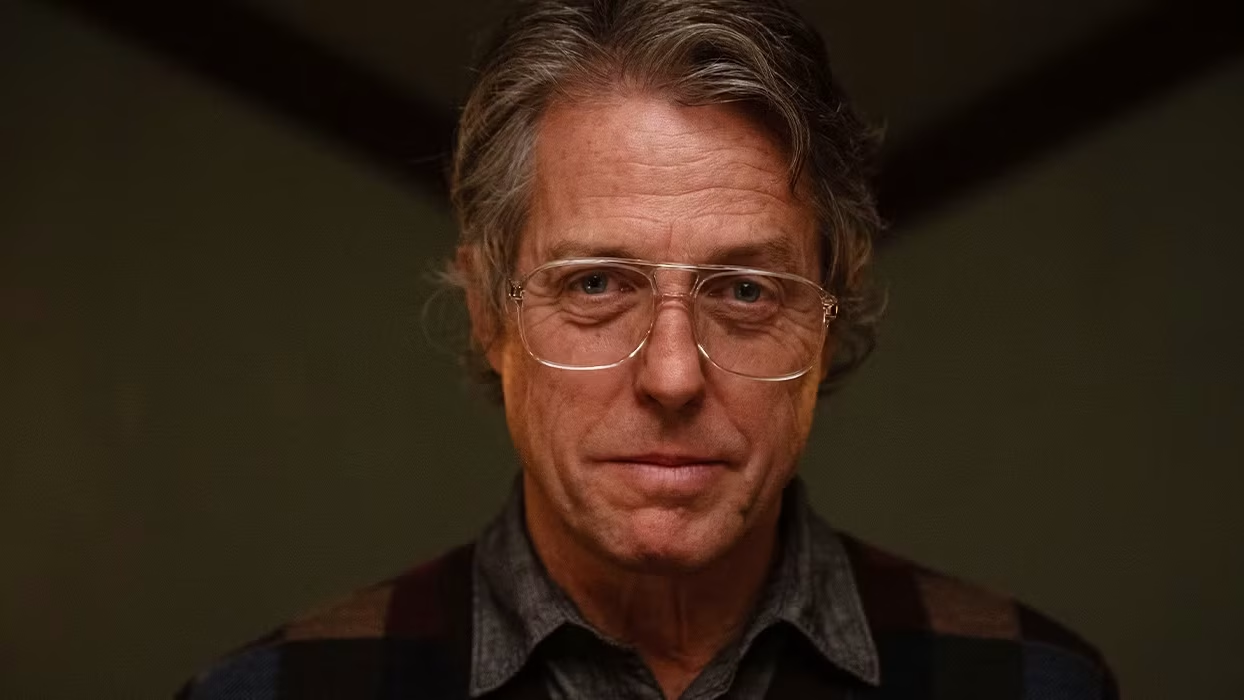
Look, Heretic was the movie I could not stop thinking about even after TIFF was over, and luckily, I didn’t have to wait too long for it to make its way to theaters. As a horror wimp who hates gore, I loved this film’s funny, tense, dialogue-based bones. Hugh Grant is perfectly cast as a man I’d describe as an “evil lecturer” who goes to intense lengths to prove his theory about religion to two Mormon missionaries (Chloe East and Sophie Thatcher.) Using his friendly demeanor and hallmark pleasantries of speech to lure in both the missionaries and the audience, his matter-of-factness when discussing darker moments is both amusing and terrifying. Does the movie make total sense? Not really, but sometimes a movie can be vibes and a fun conversation. I’d probably go into the Heretic house to have a nice chat with Hugh. It’s a must-see if you love people talking at you with a hint of menace.
Saturday Night (dir. Jason Reitman)

Saturday Night has largely come and gone, and I’m not surprised. Aside from the great performances, there’s not much substance to this film, which takes a fairly linear approach to the chaos of running the first episode of the now 50-year-old live show. Because of the (too?) colossal cast, it takes a lot to stand out — and my standouts included Andrew Barth Feldman as a harried staffer sent on a trip (and a trip), Nicholas Podany as a ’70s-era Billy Crystal, Lamorne Morris as Garrett Morris (who actually gets some characterization), and Ella Hunt as a ferociously funny and energetic Gilda Radner. The set design is the show’s star here, and all the actors work well together! Ultimately, the story wraps up without much tension and much of a point, an unfortunate takeaway from a cast with so much potential. Saturday Night is a great idea, but its triumphant closing feels unearned.


You must be logged in to post a comment.