

Who could ever forget the way Meg Ryan simulates an orgasm in the middle of a very uncomfortable diner audience in When Harry Met Sally? Or the way Julia Roberts, being just a girl, stands in front of a very handsome Hugh Grant, telling him she loves him in Roger Michell’s classic Notting Hill? The list of memorable one-liners from romantic comedies is endless. That’s to say, no matter how often the genre is relegated to gendered stereotypes or fantastical exaggerations, it’s one of cinema’s top enduring genres. Without romantic comedies, where else would we go to dream about love?
The team here at Screen Speck took the challenging task of listing out some of our favorite romantic comedies. There’s no rhyme or reason to this list but to show love to a genre that is often sidelined in its importance to film history canon.
Players (Trish Sie)

I love an underdog, and so does Netflix’s hidden gem, Players. Trish Sie‘s romantic comedy for Netflix came out in 2024 to lukewarm, if not unfavorable, reviews from critics and viewers. However, there’s an inherent charm to this movie. It’s surprisingly sweet, with a predictability that’s as comforting as it is heartwarming. Mackenzie, or Mack as she prefers, played by Gina Rodríguez of Jane the Virgin fame, is a 33-year-old sports journalist. When she’s not covering subpar sports matches that include turtle racing and chess-boxing, she enjoys running plays with her best friends. The goal? Successful hookups based on lies. But boy, are they fun to watch. She’s the mastermind behind it all, enjoying the sport for what it is, pure fun. That is, until she meets her match: a hookup she wants to turn into a relationship. At this realization, Mack comes to terms with the reality that maybe she’s ready to grow up. She’s tired of dating men who behave like children. She wants to settle down with a grown adult.
The best part of this film is how it makes you believe in love. It takes place in some of my stomping grounds in the city, following people who resemble those we know in our own lives. The problems are realistic, and the plot points are believable. It’s refreshing to witness romantic dilemmas amongst those in their thirties that still haven’t got it all figured out, because the reality is that most of us don’t. The economy is on fire, politics are dire, and potential partners are emotionally unavailable. Directed by Trish Sie and written by Whit Anderson, they were able to capture the accuracy of what many face in the dating scene at the moment, especially in a diverse city such as New York, where people of all walks of life are searching for a romantic comedy ending of their own.
Long Shot (Jonathan Levine)

Chemistry, that fickle thing, can make or break a rom-com. In Long Shot, Charlize Theron and Seth Rogen’s unlikely comedic and sexual chemistry makes up for a multitude of sins. As Charlotte Field, a high-profile stateswoman running for the presidency of the United States, Theron delivers one of the most surprising and impressive performances of her career. (“We don’t negotiate with terrorists, but we do negotiate with homies” should be considered just as iconic as Furiosa falling to her knees in the sand.) Rogen plays Fred Flarsky, a decidedly unglamorous political reporter who just so happened to grow up with Charlotte. She used to babysit for him, and his younger self had a raging… crush on her. When circumstance brings Fred and Charlotte back into each other’s orbit, they fall in love–to the utter disbelief of everyone around them.
Like the characters in the film, audiences in 2019 didn’t seem ready to accept Rogen and Theron as a believable match either. Long Shot flopped theatrically, and I’ve been stumping for this movie ever since. Charlotte and Fred are easily one of the cutest rom-com couples this century. Against all odds, the progression of their relationship feels natural and easy. While the film’s egregiously out-of-touch political commentary may verge on offense, Long Shot delivers as a swoon-worthy raunch-com with a refreshingly modern take on what ambitious women want in love. Hint: it’s not to ditch her career in the big city and find a hunky conservative in a small town. She wants a man down so bad that he’ll masturbate to a video of her being good at her job.
How To Lose a Guy in 10 Days (Donald Petrie)
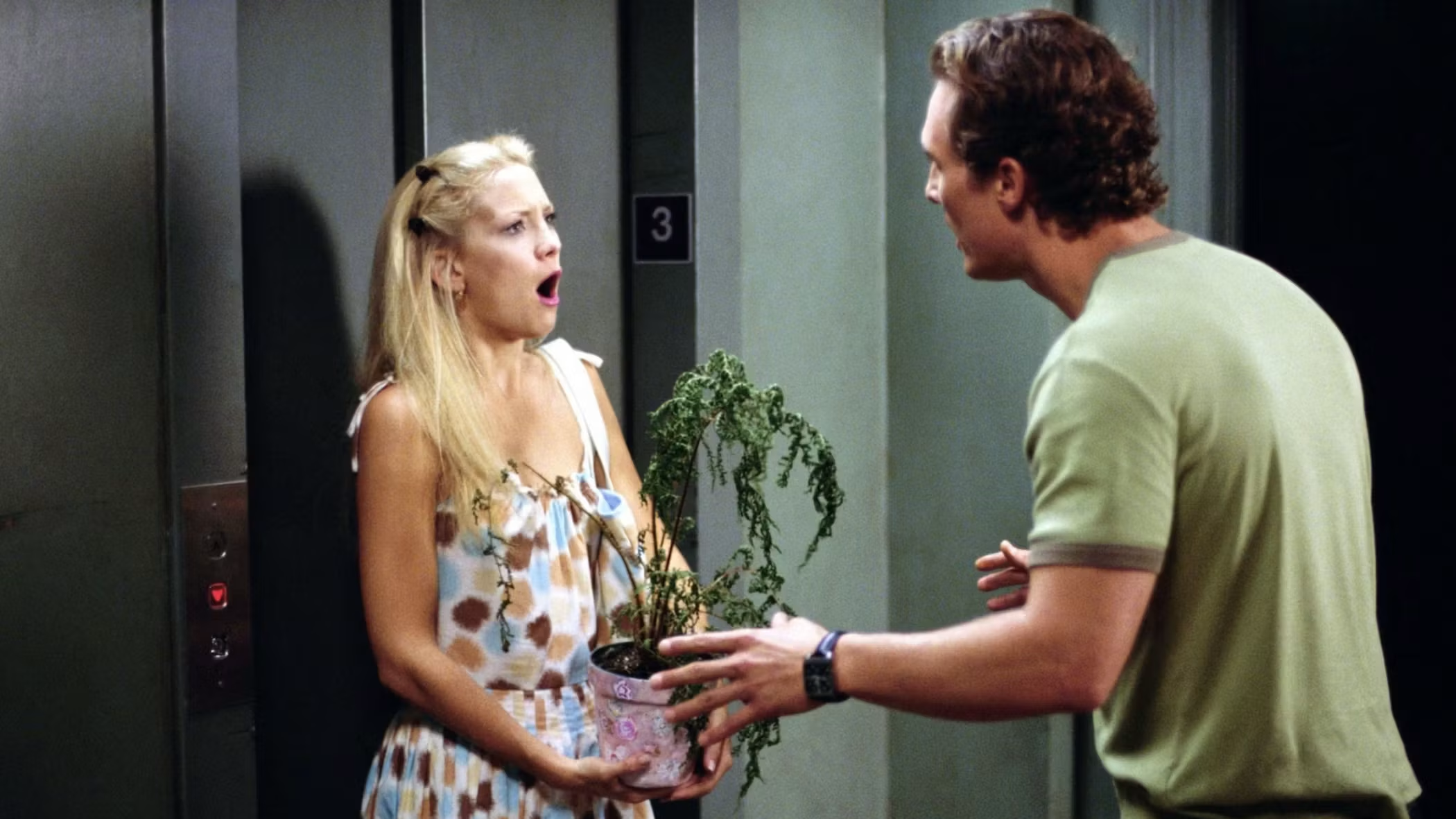
Picture this: you’re a writer stuck in a rut of writing things you don’t enjoy, and your boss gives you the opportunity of a lifetime. The catch? Falling in love, obviously.
How to Lose a Guy in 10 Days focuses on Andie (Kate Hudson), a current fashion listicle writer who aspires to be a political writer. When her boss prompts her with the article “How to Lose a Guy in 10 Days,” detailing all the ways to get a man to break up with you, she chomps at the bit. Then, she meets the perfect target: Ben (Matthew McConaughey), who is running a bet of his own with friends: how to get a girl to fall in love in two weeks. It’s a campaign for his job in jewelry marketing, and it makes the movie all the more alluring when you realize the two are fighting against each other for almost the same thing.
Kate Hudson plays Andie to a T: she yells, she cries, she runs away. She even hires a “therapist,” who turns out to be her coworker, played by Kathryn Hahn. Opposite her, we have Matthew McConaughey playing Ben, the ever-understanding “gentleman,” in heavy quotes, sweeping Andie off her feet, one love fern at a time.
Throughout the movie, we hit all the classic tropes: Ben’s family loves Andie, much to her confusion. There’s a chase-to-the-airport scene, and there’s even an abrupt rainstorm that forces the two to shower together. The fight at the end is one of the best in any rom-com ever. It’s loud, in front of a crowd at a public event, but still quiet, between just Andie and Ben. We get yelling, love confessions, and Andie almost stealing a priceless gem.
How to Lose a Guy in 10 Days is a delightful two hours spent with two leads who have enough chemistry to cause an explosion when we finally see them kiss. The movie’s soundtrack, along with its cast and writing, leaves you with a feeling of absolute and total joy, and there’s nothing better than that.
Sleepless in Seattle (Nora Ephron)

There’s nothing quite like the feeling of a good romantic comedy lodging itself in your heart. The best ones are the rom-coms you see when you’re young and impressionable – when love feels like an all-encompassing force field you’re sure to find just around the corner. That’s how it felt to watch Nora Ephron’s Sleepless in Seattle for the first time. It’s a physically tame love story; Meg Ryan and Tom Hanks don’t even formally meet until the very end of the movie. Let alone kiss. Yet I find myself returning to this story. Of the widowed father and the woman who falls in love with his voice through a radio show, time and time again.
Because Sleepless in Seattle is the kind of love story that makes you believe in destiny. This bicoastal narrative, in which Annie Reed (Ryan) and Sam Baldwin (Hanks) fall in love with the mere idea of each other, defies logic. Since so much of the rom-com genre is about defying all conventional norms, though, the defiance is precisely why Sleepless works. In this world, love is real; love is enough. Love can travel across the United States because it’s crazy not to fall in love with an idea. Which is precisely what Annie does and precisely why we eat it right up. And to be fair, who wouldn’t fall for recent widower Tom Hanks, whose adorable kid calls a radio show in the hopes of finding his grieving father a new wife? This poor articulate, mature man, who was so deeply in love with his dead wife that he couldn’t fathom ever finding again what he once had? (But you hope he does–with you.)
Exaggerated plot aside, every time I revisit this classic, I can’t help but feel unmoored. Ephron’s absence is a significant void in our media landscape. It’s as if her death took everything memorable about the genre with it. And Sleepless encapsulates the writing, the acting, and the particular Ephron romantic comedy mystique. Who today could get away with a film where the two leads don’t kiss at the end, but instead make hand-holding scandalous and exhilarating?
Rye Lane (Raine Allen Miller)

Ambiguity has become the killer of the rom-com. Most rom-coms today aren’t bad; they’re something worse: forgettable. In the age of hashtag relatability, it feels like these movies’ purpose has become to present us with the blandest, putty-like characters and situations onto which we can then project our desires, hopes, and feelings. They’ve offloaded the work of the story onto the viewer.
Not Rye Lane, though.
Rye Lane follows twenty-somethings Yas (Vivian Oparah) and Dom (David Jonsson) as they try to figure out what they want to do with their lives, while also helping one another get closure for their respective breakups. It’s an incredibly self-assured debut from Raine Allen Miller. She leans into the hyper-specificity of South London to ground the story and its characters. Dom’s an accountant, but, and this is important, he doesn’t dress like or talks like one for the entire runtime. He’s a guy going through some tough times who happens to be an accountant. We learn that he also enjoys making pour-overs and dislikes spicy food. Yas, similarly, isn’t defined by her difficulties breaking into the film industry. She loves A Tribe Called Quest, is good at karaoke, and knows how to make hummus. You learn things about these characters the way you would about your friends. They may not be the most relevant details to the plot, but they help us better understand these characters. It may feel counterintuitive, but specificity is what makes things feel genuine.
There’s a real texture to these characters, a granular attention to detail that elevates the story. They’re not written as blanks for viewers to fill in, but like real people, so that when you’re watching Rye Lane, you’re able to go, “Oh, that’s like me/my friend/sibling/whoever.” You’re not doing any work to make the story accomplish its goal; you’re just enjoying the world that Rye Lane has invited you into.
America’s Sweethearts (Joe Roth)

Do you remember when John Cusack was in his leading role in the rom-com era? Because I do. One of his rom-coms was such a foundational viewing experience for me as a child that I have been endlessly shocked to discover in adulthood that practically nobody has heard of it. Disgraceful, by the way. Starring Julia Roberts, Catherine Zeta-Jones, John Cusack, and Billy Crystal, America’s Sweethearts is about a prolific, famous ex-couple who are being maneuvered together to do press for the last movie they filmed together before Gwen (Zeta-Jones) cheated on Eddie (Cusack) with her co-star Hector (Hank Azaria). This mess is happening because the studio is desperate for a hit after a series of flops, but the director won’t release it without a press junket.
As you can imagine, Eddie wants absolutely nothing to do with Gwen, and Gwen doesn’t want to revisit her old life in that way. Gwen’s younger sister Kiki (Roberts) ends up being the go-between for Lee, Eddie, and Gwen, and shenanigans ensue. The press junket is attended by Eddie and Gwen, when Hector shows up and starts a fight (Azaria is delivering the most insane accent in this role). Meanwhile, Kiki is in love with Eddie, the press continues to bring up Gwen’s cheating, and Eddie’s subsequent mental breakdown. It’s so delicious. You’re probably wondering who the hell the couple in this movie is supposed to be. Or maybe you’re not. It’s Kiki and Eddie. Eddie gets his head out of his ass about Gwen and realizes he loved Kiki back, and it’s phenomenal. Watching these messy people try to promote this film while not caring about one another anymore, as the press is poking around their private relationships, is cinema.
While You Were Sleeping (Jon Turteltaub)

Admittedly, While You Were Sleeping holds a special place in my heart because it’s my earliest memory of being in a movie theater. It’s the movie I’d most describe as a nice, warm fireplace. But it’s also the rom-com I’ve returned to repeatedly over the years because of how deftly it mixes the sweet with the sad. Like many rom-coms, the plot is slightly deranged – Lucy (Sandra Bullock), a ticket booth operator in Chicago, saves the life of a man, Peter (Peter Gallagher), whom she’s long harbored a secret one-sided crush on. Through a series of miscommunications, Peter’s family comes to believe that she’s his fiancée. As she’s ingratiated into them, they begin to feel like the family she never had, and she ends up falling in love with Peter’s brother Jack (Bill Pullman).
Now, despite how wackadoo all of this sounds, While You Were Sleeping manages to tell an achingly bittersweet story about finding love amid loneliness. Rom-coms are essentially selling a fantasy, and their believability, how much they can move the audience, largely hinges on how well they can sell those less plausible elements. That’s why having Sandra Bullock and Bill Pullman’s endless charms are the biggest key to making this whole operation work. A hopeless romantic, Lucy’s initial fixation on Peter and her inability to tell his family the truth are deeply rooted in her solitude and ordinariness. Her hopes and dreams after a lifetime of family tragedy feel relatable and authentic. And Jack, with his rugged charm, makes you immediately understand why a romantic like Lucy is so immediately drawn to him.
As important as the leads are, it’s always been the supporting characters that made this movie truly sing. The premise doesn’t work if the audience doesn’t immediately fall in love with Peter’s family just as Lucy does. The comedic unwieldiness of the Callaghan family, full of love and zaniness, brings genuine warmth to the film. You also wish you could be adopted into them, which gives Lucy’s inner conflict the real stakes here. In the end, While You Were Sleeping admirably does all of the things that a romcom needs to do to succeed, and it’s why viewers still gravitate toward it thirty years later.
– Sam M.



You must be logged in to post a comment.