

I saw James Gunn‘s Superman twice in its first weekend. I saw it again the next weekend. It’s frustrating; it feels clean, clear, and resonant. It suffocates beneath a stuffed script that never slows down: a near-trainwreck that also blurs its way into a joyride. It’s disingenuous at times, not weighty enough to grapple with the immense agony of modern war. It is also a film that dares to allow a heroic alien, one without Miranda rights, to intervene in a geopolitical conflict and represent a genuine desire to protect human lives. It is not a great film. I cannot stop thinking about it with affection.
Gunn’s long-awaited foundation for the new DC cinematic universe begins in media res, three years after the eponymous icon revealed to the world his intention to protect Earth from all nefarious entities. Superman’s plan has gone well enough that people are largely optimistic and excited about his presence, but there simply hasn’t been enough time to forge an unbreakable bond of trust between the Kryptonian and the whole of humanity. The tenuous relationship is something that Lex Luthor (Nicholas Hoult), Superman’s nemesis and the Muskesque CEO of LuthorCorp, exploits for his own gain.
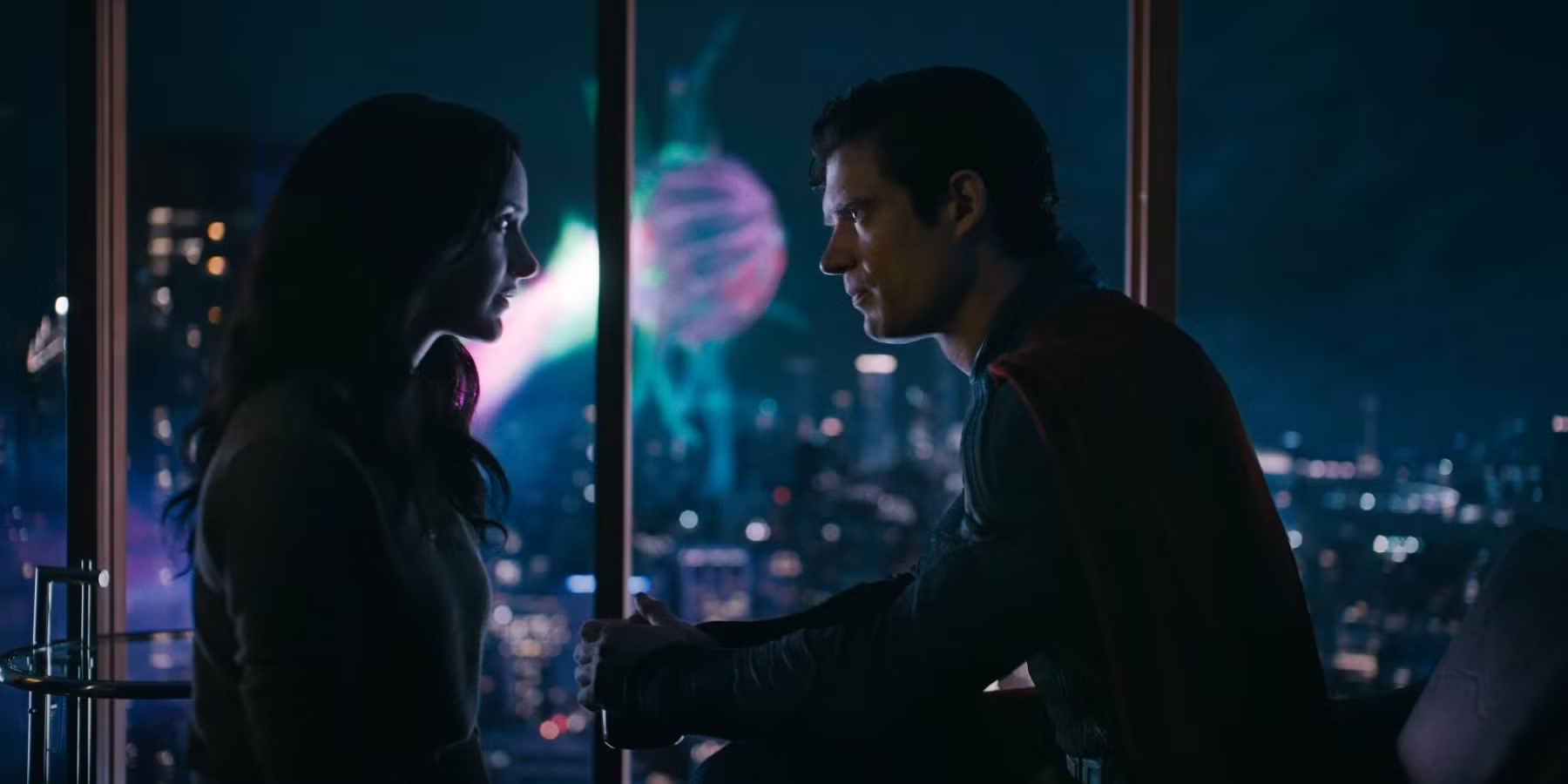
Rachel Brosnahan as Lois Lane and David Corenswet as Clark Kent in Superman. (COURTESY: Warner Brothers)
Three weeks before the film begins, Superman flew across the globe to stop Boravian dictator Vasil Ghurkos (Zlatko Buric) from invading neighboring Jarhanpur. According to Clark, in an interview he foolishly agrees to with his girlfriend Lois Lane (the remarkable Rachel Brosnahan), Superman flew Ghurkos across the desert and held him against a cactus to interrogate him (Clark does emphasize that the cactus had very small spines). Later, in a line that shocked me, we learn that Clark is quite proud of having made Ghurkos urinate in his pants as they hurtled across the desert. This is no cherubic Superman; this is a rough-edged millennial who’s sick of the suffering of others. And Clark Kent’s (David Corenswet) characterization does feel out-of-socket, inconsistent – yet Corenswet also gives one of the finest lead performances of a superhero in recent memory, embodying Superman as a luminous, sharp-edged sweetheart.
Although some viewers see a pro-Palestinian message in this movie (and there is evidence for that reading), the central conflict Superman tries to avert seems more like Russia’s invasion of Ukraine. Superman may well intend to take on multiple geopolitical conflicts; its irrepressible action and irreverence, though, make those intentions feel more like window-dressing than a meaningful part of Superman’s story.

I’m going to go back to Clark, because yes, Corenswet is my favorite thing about the movie despite my confusion about what is going on. We are told Clark is a kind, wonderful person. In fact, Lois says that Clark finds everyone he’s ever met “beautiful.” And yet this isn’t quite the vibe we get throughout a film where he’s often irritated and short-tempered with both people and situations (including the dog Krypto, who we all love very much but would never agree to pet-sit). Gunn’s film relies heavily on an audience with a strong cultural idea of who Superman is and what he’s like so his story can throw that version of Superman into the inferno to reveal sharpness and desperation. The problem with this formula is that I really want to see Clark be sweeter! With that said, Superman does try to balance its title character’s gentleness and kindness with his need to punch people, but I didn’t sense that balance until my third watch.
I really wanted to see all the characters in this get to be themselves in lower-stakes moments, something that just isn’t possible with the action sequence juggernaut that Superman ultimately is. The bones of most of these characters are so endearing, compelling, or annoying (complimentary–I’m talking about Luthor along with Nathan Fillion’s Green Lantern Guy Gardner), that I wish there were more “hang out” moments to let them breathe. We got plenty of that in Gunn’s Guardians of the Galaxy trilogy – and I recognize that those films, with their focus on a close-knit team, make that tone easier to cultivate, but more cohesion even among the Daily Planet coworkers might have been better grounding for Superman.
Speaking of which, Guardians of the Galaxy Vol. 3 is my favorite comic book movie, so I certainly believe in Gunn’s ability to craft a phenomenal narrative with high stakes and a high pay-off. That kind of movie – and that kind of feeling, of Clark’s goodness and our own potential goodness – is in here somewhere; there are moments of kindness and joy. But their roots are smothered beneath too many other ideas. I’ve spent the last several days at my job asking myself if I’m as life-affirming to those around me as I could be, as kind to my coworkers, students, and the strangers in the elevator. I know it’s because of the dang movie. Gunn’s version of Superman isn’t a masterpiece of cinema, but it scratches at what that Superman, as a cultural icon, can be. Shouldn’t Clark Kent make us want to be better? Isn’t that enough?
Rating: 6/10




You must be logged in to post a comment.