

Production designer Denise Pizzini certainly had her work cut out for her on Pluribus, taking on the tall task of building not just a cul-de-sac, but authentically portraying all the show’s international locations. Pizzini, who also worked with Vince Gilligan on the final season of Better Call Saul, sat down with Screen Speck to discuss the show’s look, working with the City of Albuquerque to create a custom home neighborhood, and the days it felt like she was actually working on the production design of a horror movie instead of an Apple TV sci-fi drama.
Screen Speck: You worked with Vince Gilligan previously on Better Call Saul. What did you like about working with him, and how do you feel that your creative collaboration with both him and the rest of the crew has evolved across shows?
Denise Pizzini: When I did Better Call Saul, I was the newbie. I did only season 6. So, they have a creative process that is different from that of many other shows. So it took a minute to kind of embrace their process, but it’s really pretty genius. They start with these very comprehensive outlines, which you could practically prep an entire episode from one outline, and everything is really detailed, so that’s super helpful. And then it goes through an extensive approval process, which is great, because then what happens is we can keep going, and it gets better, and it evolves, and then, you know, creative ideas can come out of that. And so by the time we get to shooting it, there are no surprises, and everybody has exactly what they want. He’s very open to all kinds of ideas, too, and he loves detail, which is fantastic. So, I wouldn’t say that it’s evolved. I would say that I’ve learned their process, and I like it, and the further we go, the smoother it gets.

Screen Speck: Thinking about that process, we’re still back in Albuquerque, where Breaking Bad and Better Call Saul are both set, but this show, Pluribus, still feels visually distinct, compared to Vince Gilligan’s previous shows, but also to other sci-fi shows. How did you, Vince, and the other creative collaborators decide on the look of the show and how to make it so visually distinct?
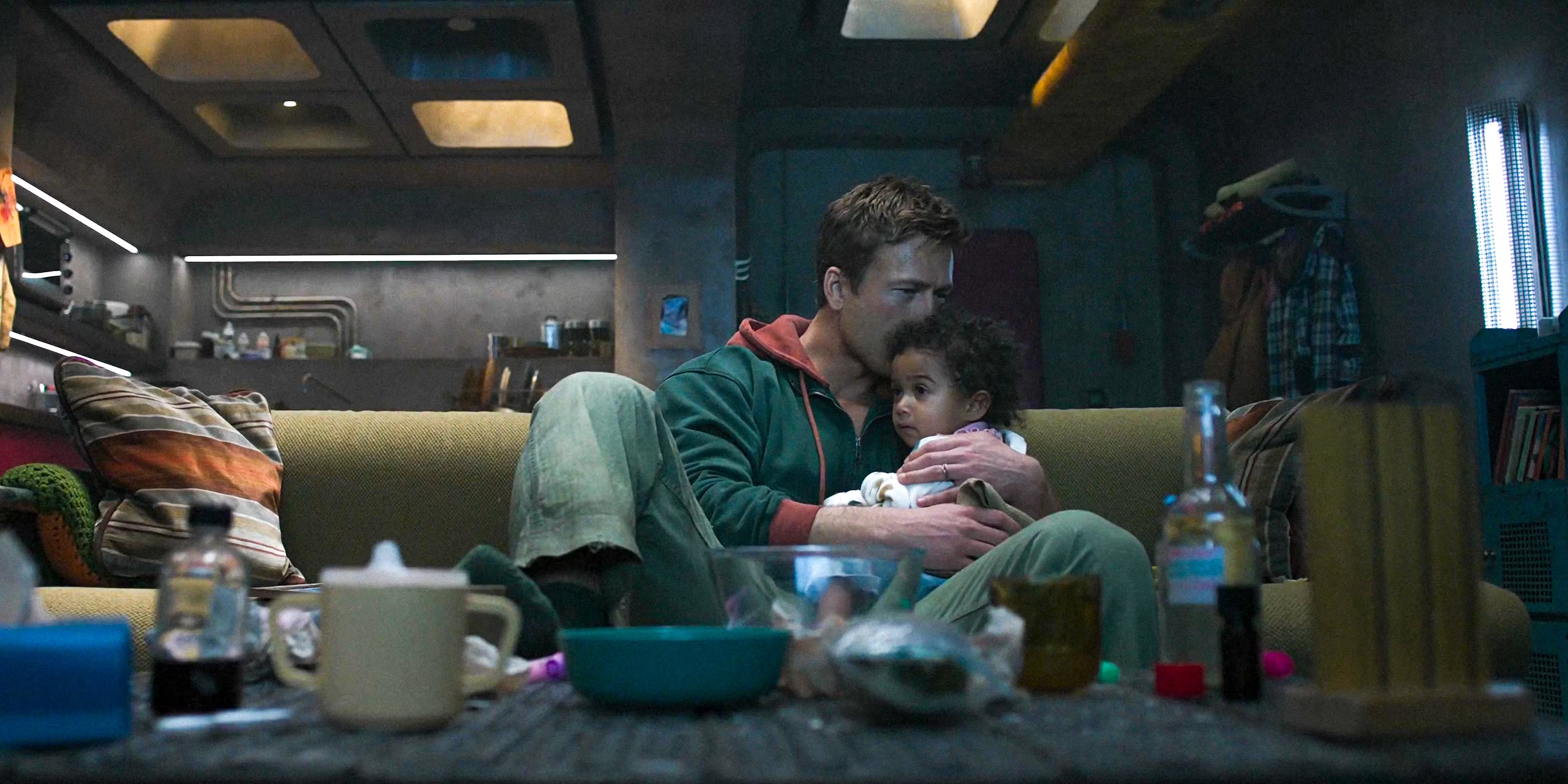
Pizzini: Well, we knew we wanted it to be separate from Breaking Bad or Better Call Saul, you know? And then we always start with the character. Who is Carol (Rhea Seehorn)? How does she live? Where does she live? How much money does she make? And then the whole concept of the show, of the world, it’s Albuquerque, and these people that join the hive mind, they are still living in a real world, in Albuquerque. So, we wanted it to look as authentic as possible, too, but a lot of it became very austere. So if you go to the hospital, very austere, orderly, clean, and organized. We embraced a lot of that, and then we left the messiness for Carol’s, as her life unravels when she’s trying to find out how to reverse this. There were details in her house that we could use, such as overgrown plants, clothes left in the living room, and dishes not done, among other things. But we wanted the outside world to become just orderly and very austere.
Screen Speck: Vince has talked personally about a lot of the other shows and movies that influenced his creation of Pluribus. I was curious if he gave you any visual references that he wanted you to incorporate, you know, whether from film, or TV, or art, or photography.
Pizzini: He did. There was a book with several photographers, a lot of them from, like, the 50s and 60s, and they would have these wide slices of life, but then there would be, like, a pop of color, and, you know, and it was a lot of the Kodachrome visually, so we kind of embraced a lot of that. It was conceptual and visual, so we married those together.

Screen Speck: Another thing that also feels special about Pluribus is that the production built this cul-de-sac where Carol lives. It has these beautiful views, basically like a 360-degree view of Albuquerque. What was the process like to essentially build a neighborhood from scratch?
Pizzini: Well, the first thing we had to do was find the right location, and the right location that we could actually get to. We were presented with a few locations that were way up on the hills, and I thought, how would we ever get trucks up here to shoot? So, we finally settled on this one location where they have allowed us to lease the land. And it had the view that Vince was really looking for. And logistically, it worked for building this cul-de-sac. So we started just plotting it out, how we had to build a road into the location, because there wasn’t even a dirt road. There was a little bit of one, and then it just ended, and it’s just open fields. So, we built the roads going in there. It’s a lot of volcanic rock, so we had to remove a lot of that volcanic rock and then grade the whole site.
And then, within the site, we figured out where Carol’s house was going to be for the optimal view, and then the surrounding houses, her neighbor’s houses, which were a little bigger, because we didn’t want Carol’s house to kind of tower over everything. So the neighbors’ houses, as we went down the hill, the houses got a little lower, and the scale was a little smaller, so they wouldn’t obstruct [the view]. We also had an area where we had our base camp, so every time we shot there, we could park all the trucks. We had to do a lot of permitting with the city, and that was something new that I had never experienced before on a production. So we went to the city, we had meetings, we had to present our plans, we had to have permits from the EPA because of the dust, and we had to mitigate that. So that was something that we had never done, and then we built the houses pretty much for real. We poured slabs, and we built real roofs and exterior walls, but the interiors are an empty shell.
I had to deal with all of that in my department, but my main thing was designing each individual house. I wanted it to look like a custom-home neighborhood, so I didn’t want them all to be cookie-cutter. I wanted them all to be a little different, even though the world is becoming cookie-cutter. But Carol’s world is not yet. And then, just things like choosing the right stucco colors for each one. The sun is so harsh out there, so I would have construction build me these giant samples that we could take out there, and we could look at it at different times of the day, and then we could look at it compared to, you know, the houses next door to each other to make sure that the colors were all right, and they were different enough, but not jarringly different. So, there was a lot involved. Everybody has to have a garage door, and a certain type of window, and certain types of front doors, and then certain types of hardware for that. And then we did a whole landscape plan for each house.
Then the set decorators went in, and they dressed all the roofs with swamp coolers, air conditioning units, stove pipes, mailboxes, trash cans, electrical meters, and water meters, and so it just, you know, it just kept going, but it was fun. It was a lot of fun, but it was very involved. The art department and our construction team really did a fantastic job, and luckily, I had people on that team who knew how to actually build houses, and so they’re out there…if you wanted to buy one, I guess you would just have to add electrical and plumbing, and interior models.
Screen Speck: I’m curious then, since you said that they are custom homes, and you did want to make them different, did you have an idea going in of who the person was who lives inside that house, maybe what they did for a living?
Pizzini: I did. That inspired some of the design choices. The art department always makes up some sort of backstory for everything. So, we did have a backstory for, you know, like, house number 6; maybe there’s a chef that lives there, and house number 2; I think we had a divorce lawyer that married a younger woman or something. Just make up all these stories, and that inspires, like, what kind of light fixtures they have. And, you know, of course, Vince approved every home, so I would do these concept boards of different types of homes, and we would make a choice, all keeping within, like, these would be homes you would see in Albuquerque. There’s no Victorian house.
Screen Speck: It’s that Adobe-style house.
Pizzini: Yes, yeah, that southwestern kind of Santa Fe style.

Screen Speck: So, thinking broader than just Albuquerque, there is an international scope here. We see a lot of Albuquerque, but we’re also seeing a lot of diversity in terms of landscape and architecture from other places. There’s the scenes that are set in Spain, there’s the episode in Las Vegas, Paraguay, we also see that ice hotel in the flashback of Helen (Miriam Shor) and Carol. Can you talk about how you went about creating all of these very distinctive international places?
Pizzini: It is a lot of work. And like I said, it all starts with the script, you know, and these outlines that are presented to us, and they’re all presented to us way ahead of time. So, like, when I see Air Force One in a script, or I see the ice hotel in a script, I can flag that stuff and know that it’s gonna take a little more time and a little more work, and then we can figure out how we’re gonna do it. You know, with the Air Force One, and then the long plane, are we gonna rent one? Are we gonna build one? How much of it do we need? Then, like, for example, the ice hotel, that’s a flashback, so just by the nature of the set, it should look different. And you do want to feel like it is a flashback, and we wanted to make it somewhat romantic. It’s a really nice moment between Helen and Carol.
And then like Manousos’ (Carlos-Manuel Vesga) garage and Manousos’ street, which has a whole different palette. All the stuff that becomes South America has a much more intense color, and anything outside of Albuquerque, like Laxmi’s (Menik Gooneratne) kitchen, where she just does a phone call, very intense, strong colors.

Screen Speck: Is there a set piece or a piece of production design that people would be surprised to find out was particularly challenging to put together?
Pizzini: There was hardly anything. We just went in and just shot. Like the hospitals, there are 3 hospitals in the show, and we have to make all those hospitals look different. So, those are always challenging. The Bilbao Airport was quite a challenge because we couldn’t shoot, clearly, at the Bilbao Airport, at least the interior. We did shoot some exterior shots there. Our location people in Spain found a building that was designed by the same architect that the airport was. So we duplicated all the signage, and we got all the seating and everything, and it was great, because then it could just be completely empty. And so that was a bit of a challenge, and also because we had one day to do it. We had to get in and get out of there quickly.
There’s a lot of challenges on different levels, different scales. The Agri-Jet, where all the body parts are, was a pretty big challenge because we actually carved every one of those body parts, and it’s a huge, huge set. It’s like 90-something feet. And it’s rows of body parts, and then beyond those rows, there are rows on the other side of it too. And I had people carving, you know, we would have different boxes, like, put the torsos here, put the legs here, put the arms here, put the heads here. It was like a big sewing circle, and they would just sit there for days. We found a way to shrink-wrap them, because Vince was very specific. It’s like a butterball turkey, which it actually says in the show. And then we would have the painters inject red paint for bits of blood. And, everything you see, there are no set extensions; it is all practical. And I don’t know what happened to all those body parts.
Screen Speck: Somewhere in Albuquerque, in storage or something.
Pizzini: That was a huge challenge. We went through, should it be mannequins? Or, you know, the mannequins weren’t looking right. Then how would a butcher do it? So you don’t have, like, arms with hands on them.
Screen Speck: Probably felt a little bit, for a second, like you were behind the scenes of a horror movie.
Pizzini: Yeah. The whole mill was just filled with all these body parts and enormous blocks of styrofoam, and I would cut them down, and the same guys that did the ice hotel were kind of running that whole thing.
This interview was edited and condensed for brevity and clarity.


You must be logged in to post a comment.