
*This essay contains spoilers for The Running Man.
To what extent of pain can we turn into fast entertainment before any enjoyment collapses under the weight of agony? When I ask this, am I introducing the in-universe show, “The Running Man,” where people fight for their lives to excite fans? Or am I interrogating the handling of oppression in Edgar Wright’s The Running Man, the film itself? Unfortunately, both. The newest adaptation of a Stephen King work revels in fiery explosions and snappy dialogue while straining to present a satirical jaunt through America’s economic injustices. What it delivers is an imprecise and generalized daydream, window-dressed in leftist iconography, signifying little. While it borrows from a violent cultural imagination of revolution, it misses the point of leftism: empathy, camaraderie, and care, not only between its characters but also in its cinematic, stereotypical depiction of those same people.
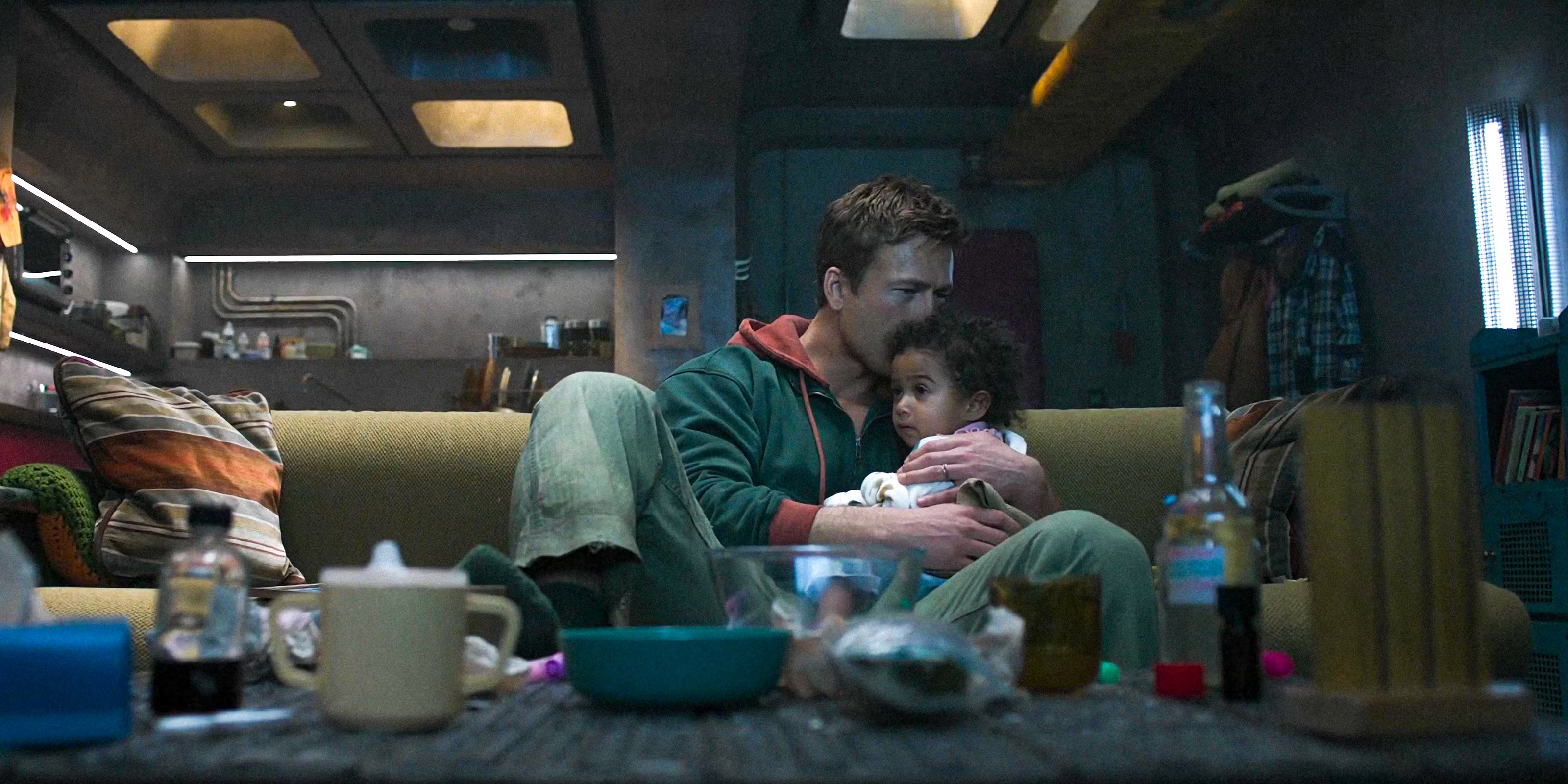
In a familiar yet alternate near-future, Ben Richards (Glen Powell) is an American husband and father, trying to help his wife Sheila (Jayme Lawson) and make enough money to buy medication for their infant daughter, Cathy (played by twins Alyssa and Sienna Benn). After his supervisors label his righteous indignation as subordination at job after job, leading to him ending up on a black list due to his interest in unionizing, Ben has one last chance. If he wants to move his family out of the slums, he has to audition for placement on a reality TV show of the network’s choice and last long enough to drum up prize money. After Ben shows high marks on the aptitude tests thanks to his aggression, the network selects him for their marquee series: The Running Man. Survive 30 days with citizens and assassins out for your life and win one billion dollars. Desperate and unsure of what to do next, Ben signs and fingerprints on the dotted line. Let the games begin. Ben dodges through spectacular action set pieces (almost all of which were spoiled in the trailer) and stirs up a revolutionary spirit in his fellow Americans, looking to rise out of their abject poverty.

The world-building is very vague for the first act, but the script reveals more and more of the nightmarish cruelty of this America. As much as the film yearns for liberation, it never seems rooted in any actual idea of what that could look like. At one point, Ben goes to record one of the daily videos he must mail to the show’s production team. He is assisted in this instance by a sympathizer to his cause named Elton (Michael Cera), who offers the choice of two sheets for backgrounds: one with the famous image of Che Guevara or another with the stylized “Circle A.” Ben instead requests a blank white background, and there’s a beat taken for humor. The white background, a marker for unadorned neutrality, seems to be Ben rejecting both political theories the symbols represent. But Elton’s possession of the two together is telling for the film’s engagement with leftism. While Guevara was a Marxist-Leninist communist, the Circle A symbol, of course, represents anarchism, two very different and clashing traditions of leftist revolution. To see them in rapid, collapsed succession textually serves to show that Elton has adopted the ornaments of revolution, but hasn’t read his political history to know these traditions are not seen as compatible (one for big state, and one for no state). Like Elton, the film and its seeming attempts at satire don’t quite know what kind of leftism they want to root themselves in, either. What we are fed is a beige stick-it-to-the-man popcorn flick when we desperately need earnest bread–and, yes, roses–when it comes to films tackling this kind of subject matter.
The idea that a Molotov cocktail, inspiring graffiti, and a fist of revenge will solve the ills of society is a flat depiction of leftist liberational movements. At the root of anarchism is not just a dismantling of the capitalist death-machine, but also a need for a new ethic of care, for a way to structure human relationships around mutual understanding. While The Running Man is caught up in the spectacle of working-class people holding aloft signs for a reckless hero who’s sick of the status quo, it fails to represent the immediate spirit of cooperation and mutual aid for others. Yes, Ben has an individualist love for his nuclear family, but his distance toward nearly everyone else leaves him with very little warmth for his neighbors, even his contestant “neighbor” Jenni Laughlin (Katy O’Brian), who he shows some care for. Ben’s is not a praxis that would last.
Although much of Ben’s distance is caused by a real fear that anyone can turn him into the network, the film does not open opportunities for him to have a genuine sense of dialogue or community beyond a few moments of fixing a stove or saving a fellow auditioner from falling. This is where The Running Man fails where a leftist action masterpiece like Mad Max: Fury Road thrives. Max (Tom Hardy) is, for his world, a working class white man exploited by those in charge, not unlike Ben. Max, however, embraces the opportunity to work with Furiosa (Charlize Theron) and the wives, forming a coalition to free them, take down Immortan Joe’s (Hugh Keays-Byrne) regime, and restore water to community-ownership. Although I have not forgotten Fury Road’s problems with ableism and fatphobia, ten years ago it offered a better sense of alliance between exploited white men and others who have it even worse. Although Ben could have had chances for coalition, he doesn’t form them, and the film doesn’t unpack this alienation. Even as he breaks bread with an anti-network family, the Throckmortons, there is a feeling that Ben is present but not engaged. Even the video he records to share his information on the network’s use of control does not feel tethered. Where is the empathy? Anger is not enough.
Okay, so maybe this film is not supposed to be about anarchism specifically, even though it’s clearly borrowing from society’s imagination of it. In our current state, or even where things were pre-Trump’s second term when Wright & co. would have been in pre-production for this picture, do we need vague, unidentifiable forms of leftist liberation? I am not asking for a manifesto. I am not asking for a detailed way out. I am not asking for a movie to save me, a queer Floridian, from those that would kill me. I am simply asking for world-building and narrative follow-through with some coherent political direction.

The film’s finale is both incohesive and inconclusive in its bombastic approach to the core themes. We see a tape (with the same host that told us about the show’s chosen archetypes) deconstructing the idea that Ben actually died on the jet, but proposing that he used a cockpit eject feature to escape. The film then moves on to a sequence of scenes that seem wrenched away from the film’s established reality. In a schmaltzily-lit scene, Sheila reunites with her husband whose face is hidden in a ANTIFA-type gaiter. (The film, it is worth nothing, dodges black bloc). We’re then in the network’s studio, where fans who used to shake signs of support for the show now boo viciously and seem on the verge of rebellion. And they do. Led by Ben, they overthrow the network as the film ends with Ben shooting the network’s leader, Dan Killian (Josh Brolin). Sitting in the theater, I couldn’t figure out whether this was a dream sequence or something that actually occurred in the story. It feels untethered, floating at the end of the narrative, with nothing to ground it as an earned ending. I’ll take it as real. OK, then, so what’s the point? What’s next after killing Killian? What new world will be built? What will healthcare look like? How will people take care of one another? No? Is it just the simple, easy images of revenge-killing and overthrow?
Beyond its shortsighted view of political theory, the film does not know how to humanize the very people who would be the worst off in its society–those in need of the revolution the story is careening toward. In the movie’s introduction to the network game shows, one segment features a heavy-set man running on an increasingly-speedy hamster wheel while answering trivia questions. It is obvious that this scene is to introduce the cruelty of the network’s fatphobia, suggesting that The Running Man as a film is dedicated to examining stereotypical media depictions. It’s not. It repeats them.
Indeed, the film falls into stereotypes when articulating some of its most vulnerable populations, particularly women. Elton’s aging mother Victoria (Sandra Dickinson) is hard of hearing and exaggerated in how she rages at Ben. She’s internalized the propaganda whole and it turns her into a gerontological cartoon. In a future where working class people have virtually no access to healthcare, someone elderly like Victoria would be doomed. Why is her whole existence played for laughs? Even if she can represent the baby-boomer who has taken the fascist bait, she is so tonally over-the-top beyond any other character that the critique fails.
Furthermore, Katy M. O’Brian’s queer character is also miserably mishandled through excessive depiction. At one point in the film, a video dissecting The Running Man explains that the show selects its contestants based on archetypes. Tim (Martin Herlihy), one of Ben’s fellow contestants, is identified as the one who will always die first. Alternatively, Ben is the “final guy.” Although they do not directly say she is the third type, there is no other slot for Laughlin. She is the hypersexual one. It’s of course okay for queer characters to be seen as sexual onscreen, but in a film attempting to critique the way media frames oppressed people, why is the only queer woman barely on screen and when she is, she has to be so limited in scope?
Perhaps worst of all the film’s sins, the two Black women, both with sick children, are rendered narratively immobile beyond being attachments to inspire the men in their lives. They worry for their children, but they are not allowed to affect the plot for the better through active choices. If this was an attempt to depict the ways society aims to strip Black women from resources, this disempowerment is not examined through a cinematic consideration of racial inequality. No, the Black women are there and then they are not. Thankfully the film does not open with Sheila’s fridging, yet her financial woes still serve as an inspiration for the white man’s journey.
Although not in any obvious way marginalized beyond her gender, Amelia Williams (Emilia Jones) is worthy of discussion when it comes to coalition. Ben, who’s values are increasingly difficult to decipher, takes her as a hostage in the third act in order to use her car. They have one of the most on-the-nose conversations about good guys vs. bad guys wherein she has a dazzling epiphany that she does not want to be one of the “bad” ones. She goes on to help Ben, but their relationship is so fraught with disdain and the threat of violence that it still, again, fails to put together a useful image of leftist community-building. Amelia feels so unrooted, so adrift in the film’s cast of characters, yet she is crucial for the big message the film tries to sell us at the climax. That message is so muddled by wishy-washy views on revenge’s place in political action that trying to pin down the point is difficult.

There is a counterargument to be had here to my points. The white men of the film do not fare well either. Tim is foolish, Elton naïve, and Killian evil beyond repair. Perhaps Ben’s own anger stems from a sense of privilege. Maybe then The Running Man is simply a misanthropic affair, still a baffling approach to critiquing the cruelty of our world. The one shining light for the leftist coalition is the Throckmorton brothers, Bradley (Daniel Ezra) and Stacey (Angelo Gray), a Black man and boy feeling the extreme effects of poverty, who work to build a coalition as best as they can. Although Ben uses them to survive and aim to return to a nuclear familial structure, the brothers’ efforts are not in vain to illustrate what anti-capitalist activists can accomplish together. The film, however, stills wraps itself in the spectacle of deep fakes and car chases when it comes to their plot. They deserve better.
If The Running Man is meant to critique media, can it really do so when financed by, well, a major media company? Can we expect Hollywood to use precision when intervening in conversations about systemic oppression? We’ve asked these questions before, and although some movies succeed despite the odds, The Running Man does not. As I said, I am not looking for a manifesto, but the fact that this movie misses the mark on the soul of leftism, on a need for mutual care and empathy, is disappointing. This film mischaracterizes leftist movements across the board, replacing nuance with spectacle.
I am a huge Edgar Wright fan and I believe in his ability to make not only engaging action-comedies like Hot Fuzz, but also meaningful considerations of human struggle like The World’s End’s and its handling of depression and alcoholism. If Last Night in Soho was a spotty (and to some, offensive) attempt at exploring misogynistic violence, The Running Man takes a different approach with a similar result. It simply does not use the language of cinema to make a useful point about the urgent subject matter. Trying to be exciting, it borrows the violence people wrongly associate with leftist progress while depicting little of the gentleness. While facing down the barrel of an American society even more miserable than ours, we are asked to have fun. I didn’t.


You must be logged in to post a comment.